Parking in Jasper requires more than choosing the closest pin on a map. Townsite fees, changing lot capacity, seasonal road rules, vehicle-length limits, accessibility needs, and temporary closures can all shape the day. A flexible plan works best: know where your vehicle fits, check current conditions before leaving, and keep a transit or alternate-destination option ready.
- Paid parking in and around the Jasper townsite follows a seasonal program, but its rate should not be assumed at every national park lot.
- A national park admission pass and a parking payment are separate requirements.
- Check JasperNow shortly before departure for current parking-lot capacity.
- Confirm vehicle-length limits before taking an RV, trailer, or large motorhome toward a scenic area.
- Review road conditions, important bulletins, and trail reports on the day of travel.
- Consider transit when staying in town or at Whistlers or Wapiti campground.
The most useful parking plan has three layers. Pick a preferred lot, identify a realistic alternative, and decide what would make you switch to transit or another destination. This approach is more dependable than building an itinerary around an unsupported promise that a certain lot will have space at a fixed hour.

Jasper Wildlife and Sightseeing Tour with Maligne Lake Hike
Discover the Maligne Valley on a guided sightseeing and wildlife tour featuring scenic stops and a 2–3 km guided nature hike at world-famous Maligne...
Understand what you are paying for
In 2026, paid parking in the Jasper townsite operates from May 1 through October 31. Parking lots covered by the program cost $7 per hour or $28 per day. Payment options include a QR code, a kiosk, and the HotSpot app. Follow the instructions posted for the place where you park rather than assuming one rate or payment method applies throughout the national park.
National park admission is separate from parking. Parks Canada lists 2026 daily admission at $12.25 per adult, $10.75 per senior, and $24.50 per family or group. Admission is free through the Canada Strong Pass from June 19 through September 7, 2026. That free-admission period includes August 26, 2026, but it does not make townsite parking free.
| Cost or requirement | What it covers | Planning point |
|---|---|---|
| Townsite paid parking | Parking areas covered by Jasper's seasonal townsite program | The 2026 lot rate is $7 per hour or $28 per day from May 1 through October 31. |
| National park admission | Entry to Jasper National Park | Admission is separate from any parking charge. |
| Trailhead and day-use parking | The specific lot where the vehicle is left | Do not automatically apply the townsite tariff to every Parks Canada lot. Follow local signs and instructions. |
If you expect to leave the vehicle for much of the day, compare the applicable hourly and daily options before paying. Save enough time to read the instructions at the lot. A national park pass displayed or carried for admission purposes does not replace any separate parking payment required there.
Use live capacity instead of relying on a fixed arrival time
There is no dependable universal hour that guarantees a parking space. Parks Canada directs visitors to JasperNow for regular updates on parking-lot capacity and campground availability. Check it immediately before leaving your accommodation, then look again if weather, traffic, or a full lot changes the plan.
- Check JasperNow while connected to reliable service.
- Confirm that the road and destination are open.
- Review the vehicle limit for the route, especially when driving an RV or towing.
- Choose a second destination or transit option before departure.
- Recheck capacity if the trip is delayed or the itinerary changes.
A live capacity tool is most valuable when you are willing to act on it. If the preferred lot is filling, switch before joining a stream of vehicles headed to the same place. The mountains will still be there, and the backup plan often saves more time than circling or waiting.
Check vehicle-length restrictions before choosing a lot
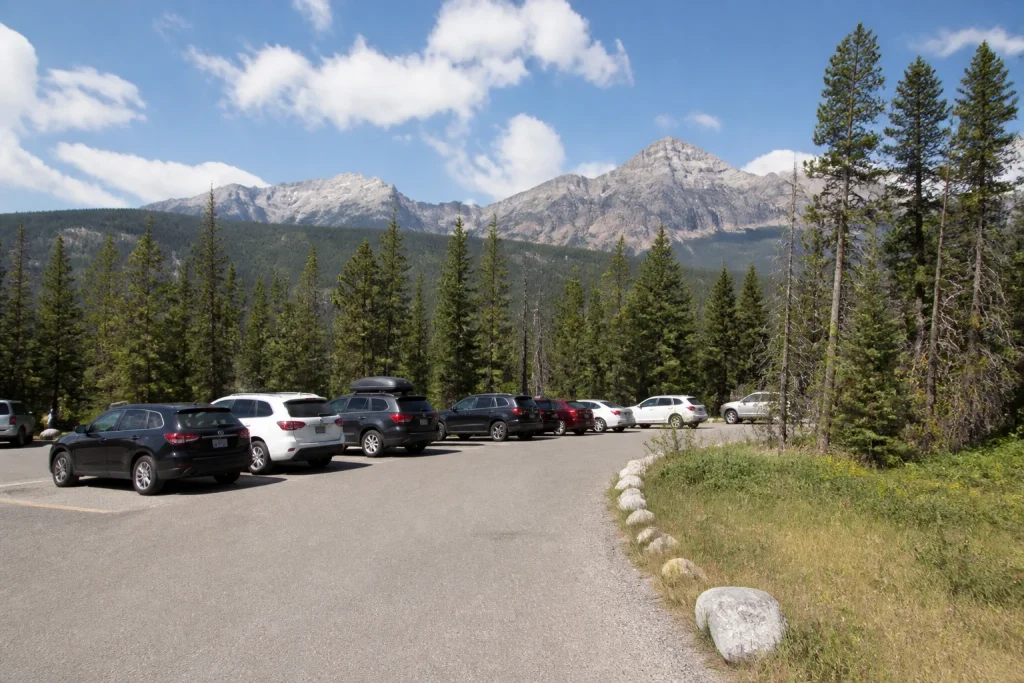
Several scenic roads limit vehicle length or prohibit RVs and trailers. These rules affect more than the drive itself. If your vehicle cannot legally use the access road, the parking area at the end is not a viable destination, even when it appears nearby on a navigation app.
| Road or destination access | 2026 vehicle rule | Dates or additional status |
|---|---|---|
| Lake Annette and Lake Edith Road | Maximum vehicle length of 6 metres; no RVs or trailers | June 15 to September 15 |
| Old Fort Point Road | Maximum vehicle length of 6 metres; no RVs or trailers | June 26 to October 26 |
| Pyramid Road and Pyramid Beach Road | Maximum vehicle length of 7.5 metres | Check current road status before travel |
| Toe of the Glacier Road | Maximum vehicle length of 7.5 metres | Check current road status before travel |
| Cavell Road | No trailers or large motorhomes | Closed for the 2026 season |
Measure the complete vehicle setup, not just the cab. Towing changes what is practical, and an RV-friendly highway does not guarantee RV access to every side road. When a route excludes your vehicle, choose transit where available, use a suitable smaller vehicle, or select a destination reached by a compatible road.

Jasper Evening Wildlife Tour
Experience the diversity and abundance of wildlife that Jasper National Park has to offer by embarking on this 3-hou...

Jasper SkyTram Roundtrip Flight Ticket
Soar up Whistlers Mountain and take in Jasper National Park from new heights. The Jasper SkyTram transports you to...

Columbia Icefield Tour with Glacier Skywalk from Jasper
Be captivated by the Columbia Icefields view Glacier-fed rivers and streams, majestic peaks, peaceful lakes and broa...
Account for 2026 closures and changing road conditions
Cavell Road and Maligne Canyon remain closed for the entire 2026 season. Ongoing wildfire recovery work addresses safety and rehabilitation concerns involving steep slopes, debris flows, and landslide risk. Do not build a 2026 parking plan around reaching either location by car.
Most trails have reopened, but temporary wildlife, wildfire, and activity restrictions continue to change access elsewhere. A closure can remove both the attraction and its associated parking from the day's options. Check Parks Canada's important bulletins and trail-condition report on the day of travel, not only when creating the itinerary weeks earlier.
Navigation apps and web maps are not always accurate in Jasper. Use Alberta 511 for current Alberta road conditions and DriveBC when the journey includes relevant roads in British Columbia. A map pin can identify a direction, but it cannot override a closure, seasonal gate, or vehicle restriction.
One upcoming change matters for early autumn itineraries. Highway 93A, also called Wabasso Road, is scheduled to allow south-entrance-only access from September 1 to mid-November 2026, with no through travel. That restriction was not yet in effect on August 26, but it affects trips planned for September and later in the season.
- Confirm the destination is open.
- Confirm the connecting road is open in the required direction.
- Check for temporary wildlife or wildfire bulletins.
- Review trail conditions before depending on a trailhead lot.
- Verify that the vehicle meets the route's size limits.
Compare accessible parking at nearby destinations
Adjacent attractions can offer very different accessible-parking arrangements. Lake Annette has designated spaces in several paved lots, while the paved Lake Edith lot has no designated accessible parking. Old Fort Point and Lac Beauvert also differ in surface, stall designation, and seasonal access.
| Parking area | Documented accessible-parking details | Important limitation |
|---|---|---|
| Lake Annette swimming-dock paved lot | One oversized designated accessible stall | No side access aisle |
| Lake Annette main paved lot | Two designated accessible stalls | The stalls share a side access aisle |
| Lake Annette lower-picnic paved lot | Two designated accessible stalls | The stalls share a side access aisle |
| Lake Edith paved lot | No designated accessible parking | Do not treat it as equivalent to Lake Annette |
| Old Fort Point trailhead lot | No designated accessible stalls | Unpaved, uneven, loose-gravel surface |
| Lac Beauvert trailhead lot | One oversized designated accessible stall in a paved lot | No side access aisle; vehicle access on Lac Beauvert Road is seasonal |
For a mobility-limited visitor choosing between Lake Annette and Lake Edith, Lake Annette offers the stronger documented parking setup. The main and lower-picnic lots include shared side aisles, while the swimming-dock stall does not. The specific lot matters, so identify the preferred parking area before setting out.
Lac Beauvert can be a more suitable parking choice than Old Fort Point for someone who needs a paved surface and a designated stall. However, Lac Beauvert's stall lacks a side access aisle, and road access is seasonal. Old Fort Point's loose, uneven gravel adds another mobility consideration beyond the absence of designated spaces.
Use Jasper transit to reduce parking dependence
Jasper has year-round transit as well as seasonal routes. The 2026 visitor update lists fares starting at $3 per ride and $8.50 for a day, plus a Jasper to Hinton connection for $15. Routes, schedules, and seasonal service can change, so confirm that transit serves the places and times needed before leaving the vehicle behind.
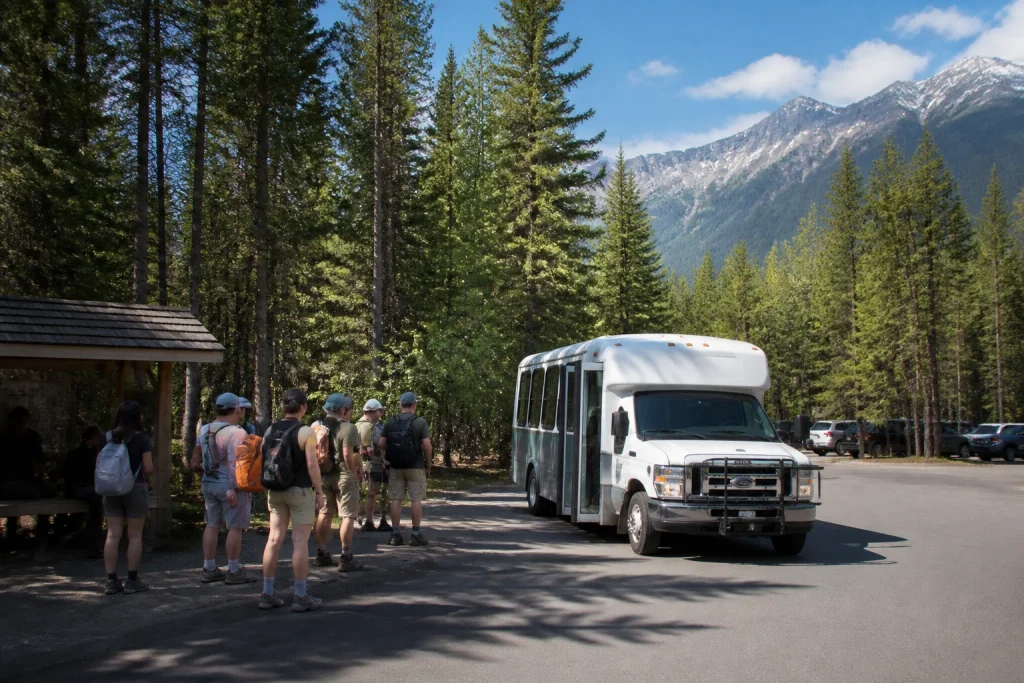
Parks Canada also operates a 24-person Jasper Transit shuttle linking Whistlers and Wapiti campgrounds with multiple stops in the park. Campers at those locations can use the shuttle to reduce driving and parking demand when its route and schedule match the day's plans.
Accommodation location can determine how often the car leaves its space. Choosing where to stay in Jasper by the kind of day you want can simplify the decision: town-based plans and campground shuttle access reduce parking dependence, while distant outings still require careful road and vehicle checks.
Still comparing Jasper National Park Parking Guide?
Ask for tour ideas, hotel suggestions, or a simple trip plan that combines both.
Trip Helper
Match the parking strategy to the destination
Jasper townsite
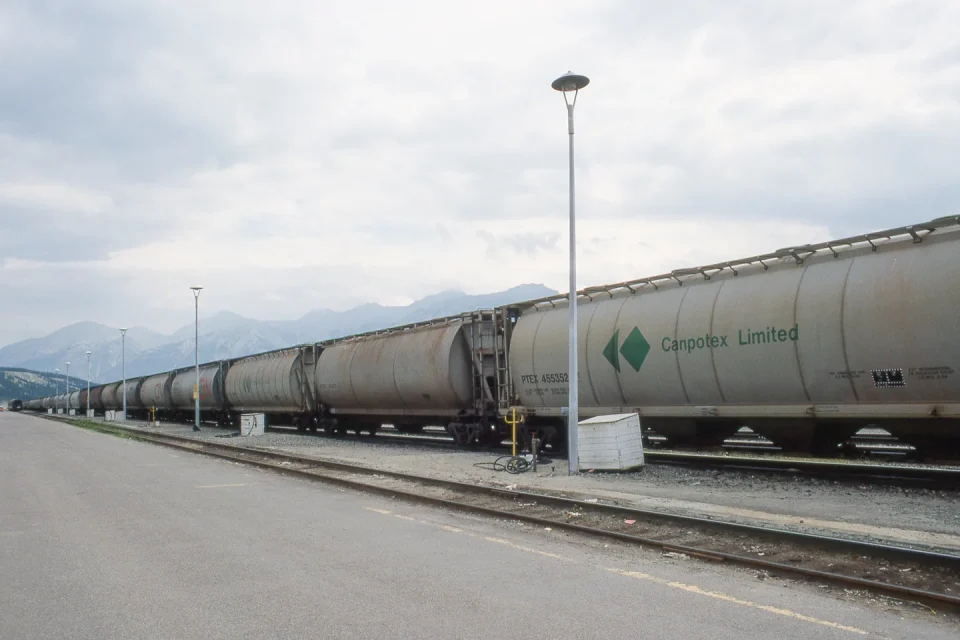
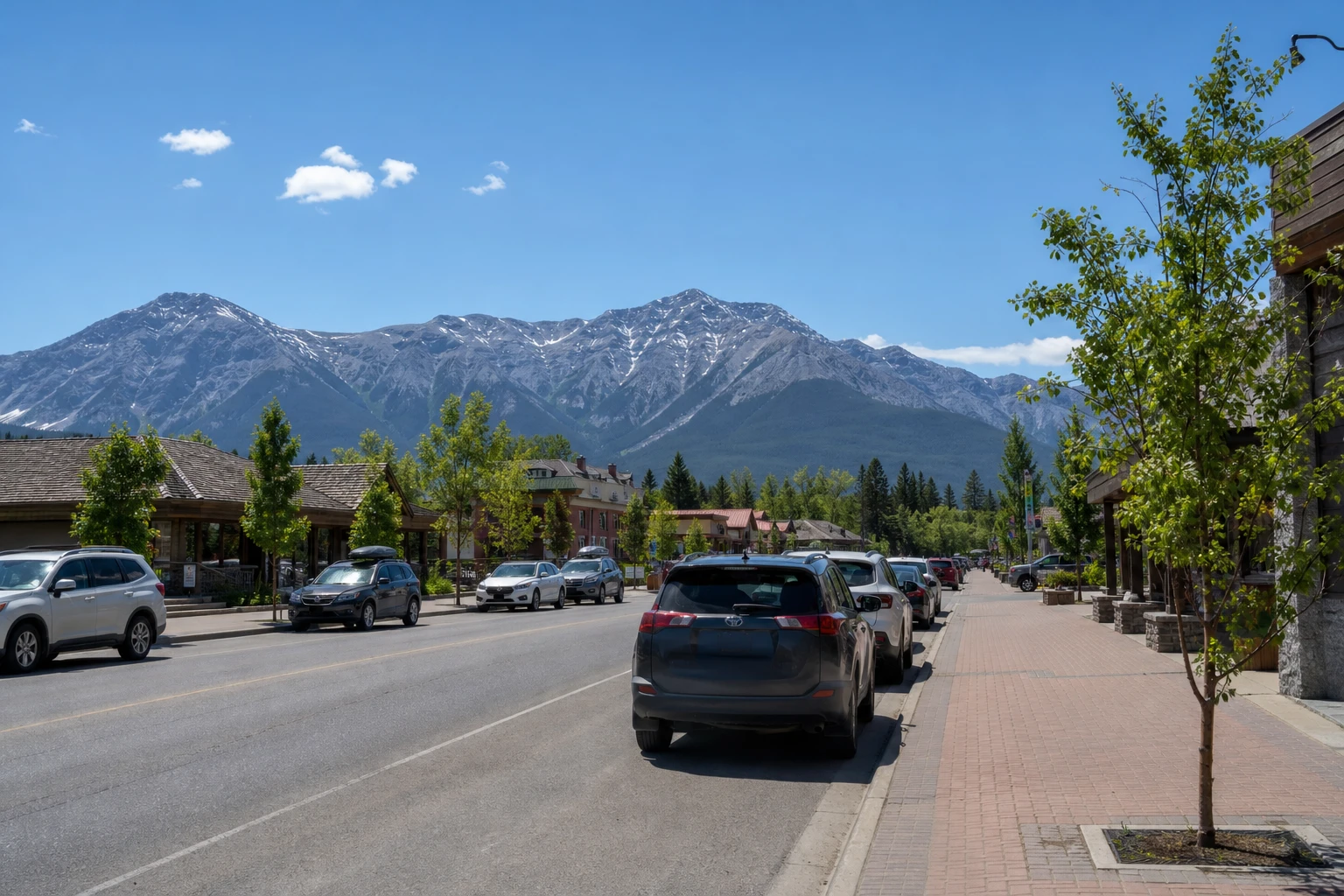
In town, confirm the applicable parking instructions and payment method before walking away. If the vehicle will remain for several hours, compare the hourly cost with the daily rate. Then group nearby stops together rather than moving the car for every errand. Walking Jasper's town and railway story is one way to turn a single parking choice into a broader town visit.
Lake Annette and Lake Edith
Drivers using Lake Annette and Lake Edith Road between June 15 and September 15 must keep to the 6-metre maximum, and RVs and trailers are prohibited. For accessible parking, choose the lake and lot carefully. Lake Annette has several documented designated spaces, while Lake Edith's paved lot has none.
Old Fort Point and Lac Beauvert
Old Fort Point Road has a 6-metre maximum and prohibits RVs and trailers from June 26 to October 26. Its trailhead parking is loose, uneven gravel without designated accessible stalls. Lac Beauvert has a paved lot and one oversized designated accessible stall, although there is no side aisle and road access is seasonal.
Longer park outings
For a longer outing, treat driving, parking, stops, and the return journey as one plan. Check bulletins, road status, and capacity before committing. If Maligne Lake is the goal, planning a Maligne Lake day without rushing the valley can help keep the itinerary flexible without treating closed Maligne Canyon as a usable 2026 parking stop.
Build a practical parking plan for the day
- List the preferred destination and one suitable alternative.
- Check Parks Canada bulletins, trail conditions, and the relevant road-status service.
- Confirm the vehicle meets every route-length restriction.
- Use JasperNow for a current look at parking capacity.
- Decide whether transit can replace one or more car trips.
- At the lot, follow posted parking, payment, and time-limit instructions.
Keep the backup destination compatible with the same vehicle. Replacing a restricted road with another restricted road does not solve the problem. RV travelers should identify alternatives along routes that accept their complete vehicle length, while mobility-limited travelers should compare the surface and stall arrangement rather than looking only at distance.
If conditions change after departure, pause somewhere legal and safe before revising the route. Recheck capacity and road information rather than relying on an earlier screenshot. Temporary closures and seasonal controls can make yesterday's plan unsuitable today.
Adjust the plan for RVs, mobility needs, and multiple stops
RVs and trailers
RV and trailer drivers should begin with road eligibility, not parking availability. Lake Annette and Lake Edith Road and Old Fort Point Road prohibit RVs and trailers during their stated restriction periods. Pyramid and Pyramid Beach roads and Toe of the Glacier Road impose 7.5-metre limits. Cavell Road is not a 2026 option because it is closed for the season.
Travelers with mobility limitations
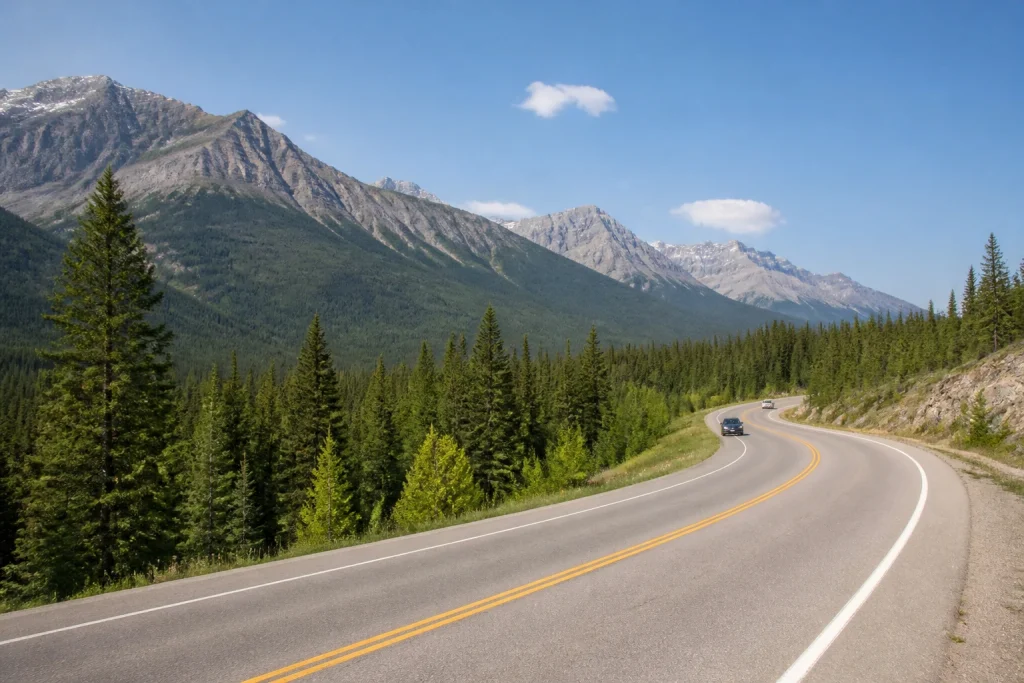
Look beyond the accessible-parking symbol. Side aisles, pavement, loose gravel, and seasonal road access affect how usable a space will be. Lake Annette's main and lower-picnic lots have shared side aisles. The oversized spaces at the swimming-dock lot and Lac Beauvert do not, and Old Fort Point has no designated stalls.
Multi-stop days
Avoid treating every stop as a separate drive. In the townsite, one longer parking session can support several nearby activities. For park destinations, cluster only those stops that remain compatible with current roads, vehicle restrictions, and closures. A shorter feasible itinerary is better than a long list connected by roads the vehicle cannot use.

Wildlife Wild Skies: Jasper Planetarium Combo
Join an interpretive guide for an unforgettable 5-hours exploring the wilderness around Jasper as well as the starry...

Tread Lightly Glacier Hikes
Join us for a unique exploration of the Athabasca Glacier on this 4 hour hike across rock, snow and ice. Meet your g...

Planetarium and Telescope Combo Tour
Discover the wonders of the night sky with our award-winning star-gazing tour package! Start your tour in the Planet...
Late-season travel
Late-season planning deserves an extra road check. The Highway 93A restriction scheduled from September 1 to mid-November 2026 prevents through travel and allows access only from the south entrance. Townsite paid parking also runs through October 31. Keep these separate rules in mind when building autumn routes and budgets.
Avoid the most common Jasper parking mistakes
- Assuming a park entry pass includes paid townsite parking.
- Applying the townsite parking rate to every trailhead and day-use lot.
- Following a navigation app without checking current road conditions.
- Driving an RV toward a destination before reviewing the access-road limit.
- Treating Lake Annette and Lake Edith as identical accessible-parking choices.
- Planning to park at Cavell Road or Maligne Canyon during the 2026 closure season.
The fix is refreshingly simple: separate admission from parking, use current tools, and match the road to the vehicle. That leaves more attention for the landscape outside the windshield and less for an avoidable detour.
Make flexibility part of the parking plan
A successful Jasper parking day starts before the engine turns over. Check current capacity and closures, confirm that the vehicle fits the route, and understand which payments apply. Travelers staying in town or at Whistlers or Wapiti campground should also compare transit with driving before committing to another parking search.
The main limitation is change. Capacity, temporary closures, seasonal access, and transit schedules can shift. Keep one practical alternative ready and make the final decision with same-day information. That small amount of preparation turns parking from the day's central problem into a manageable first step.
Frequently asked questions
Is parking free in Jasper National Park?
Parking is not free everywhere in Jasper. In 2026, lots covered by the Jasper townsite paid-parking program cost $7 per hour or $28 per day from May 1 through October 31. Do not assume that townsite tariff applies to every Parks Canada trailhead or day-use lot; follow the instructions at the specific parking area.
Does a Jasper National Park pass include parking?
No, national park admission and parking are separate. Free admission during the 2026 Canada Strong Pass period does not establish free parking in the Jasper townsite or elsewhere.
How can I check whether Jasper parking lots have space?
Use JasperNow for current parking-lot capacity updates. Check shortly before departure and again if the itinerary or travel time changes instead of relying on a fixed arrival-hour rule.
Can I take an RV to every Jasper attraction parking lot?
No, several scenic access roads prohibit RVs or impose maximum vehicle lengths. Lake Annette and Lake Edith Road and Old Fort Point Road have seasonal 6-metre limits with no RVs or trailers, while other roads have different restrictions.
Can I park at Cavell Road or Maligne Canyon in 2026?
No, Cavell Road and Maligne Canyon remain closed for the 2026 season because of ongoing wildfire-related safety and rehabilitation work. Choose another destination and check current bulletins before travel.
Which Jasper lake has documented accessible parking?
Lake Annette has designated accessible spaces in its swimming-dock, main, and lower-picnic paved lots. The paved Lake Edith lot has no designated accessible parking, so the adjacent lakes should not be treated as equivalent options.
Is Old Fort Point parking accessible?
Old Fort Point has no designated accessible stalls, and its trailhead lot is unpaved, uneven, and covered with loose gravel. Lac Beauvert has a paved lot with one oversized designated accessible stall, although it lacks a side access aisle and road access is seasonal.
Can I rely on Google Maps or another navigation app in Jasper?
No, navigation apps should not be your only source for Jasper road access. Parks Canada warns that web maps are not always accurate and directs drivers to Alberta 511, or DriveBC where applicable, for current road conditions.
Can transit help me avoid parking in Jasper?
Yes, Jasper has year-round transit and seasonal routes, and a 24-person shuttle connects Whistlers and Wapiti campgrounds with multiple park stops. Check the current route and schedule to confirm that it fits your itinerary.
Jasper Wildlife and Sightseeing Tour with Maligne Lake Hike
Discover the Maligne Valley on a guided sightseeing and wildlife tour featuring scenic stops and a 2–3 km guided nature hike at world-famous Maligne...